LinkedIn has cemented its role in 2025 as the world’s leading professional networking platform, with over 1.1 billion users globally and a deeply engaged, high-quality audience of educated professionals, managers, and decision-makers. No longer just a digital résumé hub, LinkedIn now serves as a powerful engine for career growth, talent recruitment, B2B marketing, and personal branding. Its sustained, steady growth reflects a platform in maturity, valued not for virality but for meaningful, insight-driven engagement that prioritizes relevance and long-term professional value. Content trends have shifted toward formats that educate, build trust, and position users as thought leaders such as short-form videos, carousels, and data-backed posts while analytics now focus on audience quality and strategic growth over vanity metrics. In the U.S., LinkedIn reaches more than 70% of the adult population, representing its most commercially valuable market, characterized by senior roles, high purchasing power, and dominant industries like tech and finance. With a surge in premium users, creator-led content, and sponsored campaigns, LinkedIn is evolving into a full-fledged professional media platform, central to business and career ecosystems.
Global LinkedIn Statistics (2025)
The Scale of the LinkedIn User Base
By 2025, LinkedIn has surpassed 1.1 billion registered users globally, supported by more than 310 million monthly active users. Operating across over 200 countries and territories, the platform has become the backbone of professional networking on a global scale.
This scale is significant not simply because of volume, but because of who these users are. LinkedIn’s user base is heavily concentrated among educated professionals, managers, specialists, and executives making it fundamentally different from consumer-oriented social networks.
LinkedIn Growth and Platform Maturity
LinkedIn’s growth trajectory remains steady and sustainable. With an estimated 8–10% annual user growth rate, the platform has entered a phase of maturity rather than explosive expansion. This maturity is reflected in how LinkedIn is used today.
Instead of serving a single purpose, LinkedIn now functions as:
- A professional publishing platform
- A recruitment and talent intelligence tool
- A core channel for B2B social media marketing
- A space for personal branding and thought leadership
This multi-layered usage model is a key driver behind LinkedIn’s continued relevance in 2025.

Understanding the LinkedIn Audience
One of LinkedIn’s defining strengths is the composition of its audience. Unlike entertainment-driven platforms, LinkedIn attracts users who are actively engaged in career development, business growth, and professional learning.
The table below summarizes the core global LinkedIn audience characteristics in 2025:
| Audience AttributeKey Insight | |
|---|---|
| Dominant Age Group | 25–34 years old |
| Secondary Age Group | 35–54 years old |
| Education Level | Strong concentration of college-educated users |
| Professional Role | Managers, specialists, executives, founders |
| Purchasing Power | Higher than average across social platforms |
These professional networking stats help explain why LinkedIn consistently delivers higher-quality engagement and stronger B2B outcomes compared to other social media networks.
LinkedIn Reach and Engagement Dynamics
Unlike fast-moving consumer platforms, LinkedIn prioritizes relevance over virality. A single post can remain visible and generate engagement for several days, sometimes even weeks, depending on the discussion it creates and Linkedin likes.
LinkedIn reach is primarily influenced by:
- Meaningful comments rather than passive likes
- Content relevance to professional interests
- Network proximity and engagement quality
As a result, creators and brands that focus on insight-driven content tend to outperform those chasing short-term trends.
LinkedIn Content Trends in 2025
Content on LinkedIn has shifted toward depth, clarity, and real-world expertise. In 2025, users expect posts to offer tangible professional value rather than surface-level inspiration.
The table below outlines the most effective LinkedIn content formats and their primary use cases:
| Content Format | Primary Purpose |
| Short-form video | Explain concepts, share insights quickly |
| Carousel / document posts | Education, storytelling, frameworks |
| Personal career stories | Trust-building and relatability |
| Data-backed insights | Authority and thought leadership |
The platform increasingly rewards content that encourages discussion, knowledge sharing, and professional reflection.
LinkedIn Insights and Analytics
As LinkedIn matures, analytics have become central to sustainable growth. High-performing creators and companies rely on data to guide content decisions and audience targeting.
Below is a simplified overview of key LinkedIn analytics metrics and what they indicate:
| Metric | What It Measures |
| Impressions | Overall content visibility |
| Engagement rate | Content relevance and resonance |
| Follower growth | Long-term audience building |
| Audience demographics | Seniority, industry, job function |
In 2025, LinkedIn analytics are less about vanity metrics and more about understanding audience quality and long-term influence.
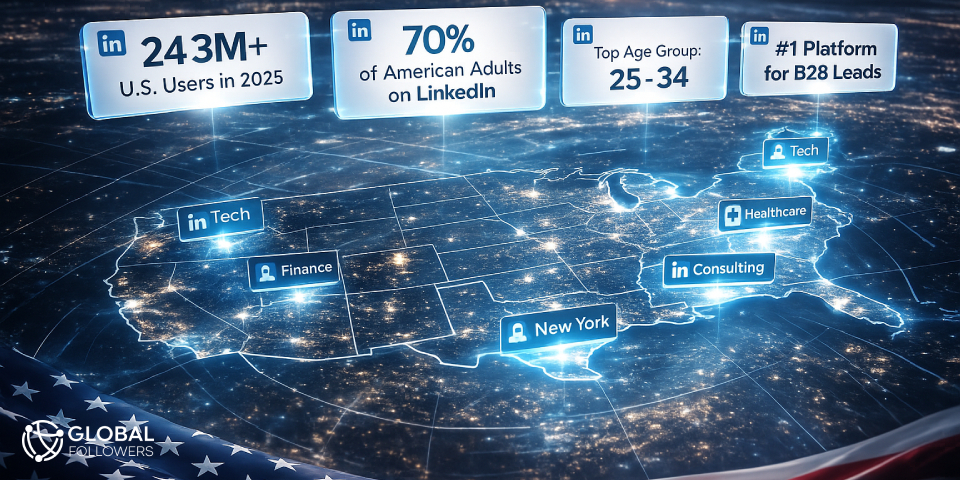
USA-Focused LinkedIn Statistics (2025)
While LinkedIn is a global platform, no market carries more strategic importance than the United States. The U.S. not only represents LinkedIn’s largest user base, but also its most commercially valuable audience.
LinkedIn User Base in the United States
As of 2025, LinkedIn counts approximately 243–252 million users in the U.S., giving the platform access to more than 70% of the American adult population. This level of penetration is unmatched among professional platforms.
For many U.S.-based professionals, LinkedIn is no longer optional it is a default layer of professional identity and communication.
Profile of the U.S. LinkedIn Audience
The U.S. LinkedIn audience reflects the platform’s premium positioning and commercial value. Compared to global averages, American users tend to hold more senior roles and greater purchasing authority.
LinkedIn has introduced a comprehensive 55-page B2B branding guide in partnership with the Ehrenberg-Bass Institute, stressing that sustainable brand ...
The table below highlights key characteristics of the U.S. LinkedIn audience:
| Attribute | U.S. Audience Insight |
| Largest age segment | 25–34 |
| Education level | Predominantly college-educated |
| Income profile | Above national average |
| Common industries | Tech, finance, consulting, healthcare |
| Decision-making power | High |
This audience profile explains why the United States remains LinkedIn’s most valuable B2B market.
Professional Networking and B2B Social Media Impact in the U.S.
LinkedIn plays a central role in the American professional ecosystem. Recruiters rely on it as a primary hiring channel, while professionals use it to build networks, share expertise, and establish credibility.
From a business perspective, LinkedIn is widely regarded as the most effective B2B social media platform in the U.S. It consistently outperforms other networks in lead quality, conversion rates, and decision-maker reach.
You may wan to check out our related article: Top 10 Facebook Statistics 2025
LinkedIn Reach and Growth Trends in the U.S.
Several trends define LinkedIn’s evolution in the American market:
- Higher-than-average adoption of Premium memberships
- Rapid growth in creator-led and video-first content
- Increased investment in sponsored content and thought leadership campaigns
These patterns reinforce LinkedIn’s transformation into a professional media platform rather than a traditional social network.
GlobalFollowers Statistics on the Services We Provided to LinkedIn Users in 2025
Throughout 2025, GlobalFollowers delivered comprehensive growth and engagement services specifically tailored for LinkedIn users. Our LinkedIn-focused solutions, including follower growth, post engagement, and profile visibility services, were used by over 90,000 LinkedIn accounts worldwide.
During the year, we successfully completed more than 520,000 LinkedIn-related service sales, supporting professionals, brands, recruiters, and content creators in strengthening their presence on the platform. Many of our clients experienced noticeable improvements in reach and engagement within a short time frame.
In terms of customer support, our team handled over 14,000 LinkedIn-related support requests, with 97% answered within the first hour. Our fast response times and solution-oriented support played a key role in maintaining high customer satisfaction throughout 2025.

No comments to show.